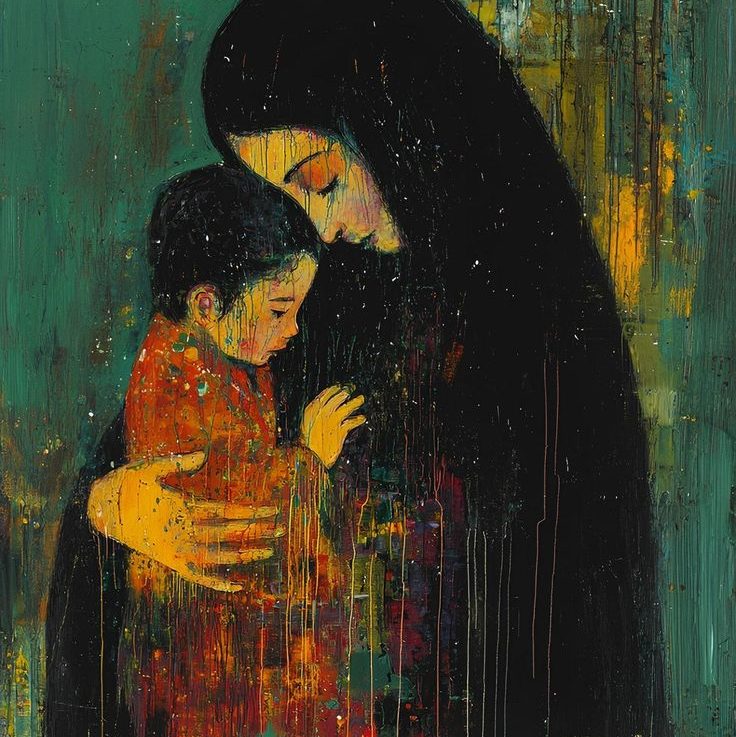
she learned to call survival a virtue – alongside her children, a persistent pressure was also born: a need to prevent their children from stepping into the same traps.
Kurdish is my native tongue. I grew up speaking, reading, and writing it (and by writing, I mean using the English alphabet, cause naw). It’s my first language, the one I spoke every single day of my life before moving to the United Kingdom, and the one I still speak fluently to this day. I was extremely lucky to have the opportunity to learn English at a very young age—I learned it when I was 6, only because I wasn’t properly placed in education until roughly year 2, so it almost feels like my native tongue, but not quite. I don’t remember having to learn the words, the sentence structures, or the grammar behind them – all I remember is being separated from my other classmates to go sit in a storage room with a tutor whose face I can’t remember. I just remember knowing how to speak it, and for as long as I could remember, most of my thoughts, the ones that narrate my life, were in English, not Kurdish.
I truly feel like two completely different people when I talk in Kurdish versus in English. It surprises me how these two people exist in one body, switching back and forth, jumping across the vast difference between them seamlessly. This miraculous act is called code switching, and it’s common among people who speak more than one language fluently.
One of the biggest reasons I love living outside my home country is that I can express myself so easily. I like the person I become when I speak English, but I do wonder from time to time what kind of person I’d be if I had stayed home. Would I eventually become who I am now because it is inevitable, or has the city and the language shaped me into who I am? The longer I live here, the further I feel from the person I could’ve been if I had moved countries a little later down the line, or even perhaps the person who never moved at all. I know, without a doubt, that I am growing much faster here, but it is sad to think about how long I could’ve gone without being able to express myself in the way I needed to. And that’s when my mother comes into the picture, that’s where I mourn.
Because she is the one who left everything she truly knew behind, she is the one who stepped into a foreign country without the privilege of being taught the English language; to this day, she still struggles with certain sentences. But most importantly, she left behind a world that taught you to bottle up emotions and stepped into one that allowed you to express yourself with ease. She entered a realm where phrases like “It hurts my feelings when…” were permissible to say aloud. If you asked me how to say that sentence in Kurdish, I wouldn’t know how to, and I doubt my mother would know either.
Expressing emotion extends beyond spoken words. Each language comes with its own way of thinking and reacting, which we absorb instinctively, often without realising. Even though I was never unsure of my mother’s love, the act of crying in front of her felt unfathomable to me. I’ve felt this way since I was as young as 5. I am now 21, and I’ve cried in front of my mother approximately 5 times and in front of my father 0 times.
In one of those 5 times, I did end up crying in her arms once. I remember feeling extremely uncomfortable and embarrassed—I was around 10. I, too, sensed her awkwardness, not knowing where to place her hands but still wanting to take my pain away. I’ve now realised that she didn’t know how to sit with my sadness because it likely hadn’t been done for her either, not by her mother, nor by the generations before her. This non-crying trait had been carefully passed down through our bloodline, and it never ran thin.
I am not much of a crier. Even as a baby, my mum said I only cried for 2 weeks after I was born, and then I just stopped. She constantly told me that she felt so lucky that I was born that way. I don’t cry and haven’t cried much now because, regardless, each time I have allowed myself to, and as liberating as it was, the lightness always quickly becomes accompanied by the flush of shame. I had lost all the strength my mother was so proud of; the pride I took in ‘being born that way’ quickly dissolved.
Not only did I grow up in a house with parents who have never talked about their own feelings, but I also grew up in a culture that fosters it too. If you’re upset, it’s expected of you to deal with it on your own, to not burden others with your sorrows. And then comes the burden of shame, the sole product of fear.
There is a quiet inheritance that passes between mothers and daughters—sometimes between mothers and sons too, though it moves differently there. It is not written in holy books or recorded in photo albums. It arrives instead in warnings, in glances, in the tightening of a jaw when certain topics are mentioned. It lives in phrases repeated so often they lose their sharpness: Be careful. Don’t give people a reason to talk. The world is not kind.
These teachings are rarely framed as ideology. They are passed down from a mother, who passed them down from her mother, who passed them down through a continuous line of generations, and then framed as love.
But beneath them sits something older and more structural: the patriarchal institutions that have been folded so deeply into cultural systems that they no longer appear as institutions at all. They look like tradition. They look like morality. They look like common sense – and so mothers become the quiet enforcers of rules they did not write.
Most mothers, I know for a fact not mine, did not invent the shame they pass down. They inherited it. It was taught to them early—sometimes through direct reprimand, sometimes through the soft humiliation of being watched too closely. A skirt that was too short. A laugh that was too loud. A curiosity that wandered too far. Somewhere in their youth, there was a moment when the world told them: There are consequences for being the wrong kind of girl.
My mother worked very hard from a young age. She was responsible early. She was without a mother and father at a very young age, which led her to care for her siblings as if they were her own children. She carried immense expectations. By the time she became a wife and a mother, she was already a fully formed adult who knew how to survive. On paper, she was doing well. She was smart and fully capable of pursuing academics, of becoming something out of nothing.
Then she got married and had children of her own.
And then something happened that is very common and yet rarely discussed honestly. Her marriage and motherhood did not expand her life. It reduced it. Her world became smaller. Her options narrowed. Her brightness dimmed. Not dramatically. Not in a way that makes for good stories. Slowly. Quietly. Respectably. All that became was the duty of being a mother in an unkind world, a world of culture and traditions. Her time of inheritance finally knocked at her door. Children came. Expectations multiplied. Sacrifice became normalised. And like many ethnic women, she learned to call survival a virtue – alongside her children, a persistent pressure was also born: a need to prevent their children from stepping into the same traps.
At first, when you’re young, you don’t see it at first glance; it looks a lot like control, if not identical, but if you stand still long enough and squint your eyes just the right amount, you start to see what it really is – fear. It becomes evident, so insanely visible that it feels as though you could hold it in your palms, but you can’t, because mothers are already carrying it within their souls.
Fear of the gossip that can hollow out a reputation. Fear of the men who mistake kindness for permission. Fear of systems that punish vulnerability more harshly than cruelty. Fear of a world that has historically been far less forgiving to daughters.
So, the mother teaches vigilance.
She teaches it in the way she watches the clock when her child stays out too late. In the way she corrects posture, clothing, and tone. In the way she warns about appearances, about dignity, about what people will say. It becomes suffocating, and it feels like your every move, every breath, is judged – but to them, it’s protection. It’s the prevention of the past coming out of the grave.
What complicates this inheritance is that patriarchal systems are particularly efficient at turning survival strategies into moral obligations. Over time, the protective rules mothers learned come to be framed not simply as necessary, but as right. The shame that once wounded them becomes reinterpreted as guidance.
A mother who was shamed for speaking too boldly may later teach her daughter to soften her voice—not because she believes her daughter deserves silence, but because she remembers the punishment that follows loudness.
In psychology, it is seen as protective hypervigilance, which is a trauma-related psychological pattern where someone becomes constantly alert to potential threats, especially threats that could harm people they are responsible for. It often develops after experiences of humiliation, social punishment, violence, instability, or chronic judgment. The brain learns that anticipating danger is the safest strategy.
For mothers, this can translate into parenting behaviours like strict monitoring of behaviour, correcting clothing, tone, posture, worrying about reputation or public perception, or repeatedly warning children about risks. Psychologically, the mother’s mind is trying to predict harm before it occurs. What looks like an overreaction to the child often comes from a nervous system trained by earlier experiences to believe:
“If I do not prevent it, something bad will happen.”
Over the decades, this constant alertness keeps the body in a mild but persistent state of stress. Stress hormones like cortisol remain elevated, which can affect sleep, skin elasticity, inflammation, and energy levels — one reason long-term worry can physically age someone.
Internalisation becomes rooted, and social rules become so normalised that people absorb them as personal beliefs or instincts. Instead of the system needing to actively enforce every rule, individuals begin enforcing them themselves, and this is how large cultural systems sustain themselves across generations.
And although, thankfully, my mother is not the typical traditionally strict outcome of this, she is still a little girl who became a mother too soon – the more I grow older, the more I notice how my mother’s body remembers those moments even when her mind tries to move past them. It shows in the moments where her eyes slightly widen when they see the smallest ounce of skin, in the moments where her body slightly tenses when a topic I strongly disagree with is being discussed or when a male relative makes a sly misogynist comment while I’m present. In the moments where she struggles, when tears are meant to take place, but instead a weak half smile remains glued to her lips.
Alongside her bodily mannerisms and the way her eyes speak, I’ve come to notice it in her ageing, or more so, I’ve come to notice that it is the sole thing that ages her. Looking closely at her face, I see that the lines that gather around her eyes are not only the result of time, but they are the result of decades spent anticipating harm before it arrives. The body absorbs worry the way stone absorbs rain—slowly, persistently, until the surface begins to change. You see it in the small crease between the eyebrows, formed by years of concern. In the tiredness that settles into the shoulders. In the way her voice sometimes tightens when speaking about the future.
It is easy, especially when we are young, to see those marks as severe. To interpret them as harshness, or rigidity, or unnecessary caution. But with time, it becomes clearer that many of these expressions are the physical record of a lifetime spent trying to shield someone else. Our mothers aged not only from their own living, but from worrying about our living.
There is something tragic in this arrangement. Patriarchal systems create the conditions that produce shame, yet the labour of managing that shame falls disproportionately on women—especially mothers. They become the translators of danger. The guardians of reputation. The ones who must quietly anticipate the ways the world might harm their children.
Even when they disagree with the system itself, they are still forced to prepare their children for it. This is one of the most invisible burdens motherhood carries.
But there is also something quietly powerful in recognising this inheritance for what it is. Because once we name it—once we understand that much of our mothers’ strictness was born from fear rather than cruelty—we gain the ability to interrupt the pattern. Not by rejecting our mothers, but by understanding the conditions that shaped them.
The fear etched into their faces need not be the only legacy they pass down. If anything, their lives offer us a map: a record of where the pressure has historically been placed, and how deeply it has carved into the people who came before us.
Watching mothers age does something to a daughter. It teaches you early that womanhood can be a place where dreams go to die. You can deny it and use the word postponed instead. But what is infinite postponement if not death?
Watching the history she went through lay across her face and take a permanent mark on her body teaches you that love can demand too much. It teaches you that being good is often rewarded with exhaustion. So, I decided I was not going to put myself in that position. Not because I am better than my mother. But because I am her continuation. And continuations are allowed to evolve.
I think this is why it is so important for women to do the things their mothers never got to do. If your mother never got to finish school, you should. Absolutely. Not because education is a trophy, but because it expands your thinking and your options. My mother would often remind me that she wished she had just gone to school and expected better from me. Not once has she scolded me or bickered for me to go study; she isn’t even aware half the time when I do or don’t study, because it was never about pressure. It was about, and always will be, memory and regret – regret that she couldn’t become something out of nothing and expects me to do so instead – to become something out of nothing. It stayed with me. It shaped what I believed was possible and expected.
If your mother married poorly, you are allowed to marry well. You are allowed to take your time. You are allowed to be selective. You are allowed to learn from her experience without inheriting its consequences.
If your mother moved from marriage to marriage, or stayed in one that drained her, you are allowed to choose stability, or even solitude, if that brings peace. If you were raised by a single mother who carried everything alone, you are allowed to decide that your children will grow up in a stable, loving, two-parent home. That is not a rejection of her strength. It is a refusal of her burden.
If your mother endured abuse, humiliation, or disrespect because leaving was unthinkable, you are allowed to decide that no love is worth that price.
And if your mother never worked outside the home, or never controlled her own money, you are allowed to choose differently. You are allowed to build power. You are allowed to be your own boss. You are allowed to call the shots.
This matters deeply for not only Kurdish women, but for any ethnic woman, because our cultures are built on continuity. We inherit not just surnames, but silence. We inherit endurance. We inherit the idea that a good woman adapts, absorbs, and endures.
But progress does not come from endurance alone. It comes from discernment.
Choosing differently is not about rejecting our mothers. It is about refusing to romanticise their suffering. It is about understanding that many of them did the best they could with limited choice, limited rights, limited economic power, and heavy social expectations. We have more information now. More access. More language. More room to breathe. And with that comes responsibility.
Your mother did not suffer so that you could rehearse her suffering in a different decade. She suffered so that you might have a chance to choose better. To live more fully. To say no where she could not. To walk away from where she stayed. To ask for more where she settled.
Doing what our mothers never got to do is not betrayal but generational repair.
It is saying thank you and then going further.
And that, I think, is one of the most loving things a daughter can do.
 The Inner Lens
Leave a comment