empathy is never meant to be a weapon against oneself.
The first time my character was described and labelled ‘nonchalant’ was by someone close to me. I was utterly dumbfounded; I didn’t know whether to laugh or be heartbroken at the sole fact that my entire existence had never been perceived but instead misunderstood. Instead, I just sat there, in silence. My silence, I’ve come to understand, is what people misunderstand as ‘nonchalance’. I walked away from that statement slightly infuriated, because nonchalance is a performance, a controlled indifference, people deliberately present themselves in that manner, whereas the reason behind my lack of emotion and interest in certain situations is because of apathy – something that I do not choose to perform, but rather something that has been installed in me over time.
I have sacrificed myself for hands that could never hold me. I stayed small to preserve peace. I ignored my intuition. I swallowed instincts that whispered, “This hurts,” because I believed empathy was my shield, that if I endured enough, I would not lose anyone.
But empathy is not protection when it excludes you. Instead, it becomes your executioner. I held myself to standards I would never impose on another human being. Where I called myself ungrateful for wanting more, I called others ambitious. Where I saw weakness in my own hope, I admired courage in theirs. Where I believed I was “too sensitive,” I told others their emotions were valid. I called it compassion. But I was never compassionate with myself.
For the longest time, I questioned how I could possibly be someone who is apathetic, someone who can’t express emotion socially. I am a writer. An apathetic person cannot write such “heart-wrenching” texts, cannot dive so deeply into thought and emotion. Literature and poetry are for people who care, care a lot, care so much that they have to put those emotions into rhyming verses and metaphorical sentences. Into something you either feel under your skin when you read, or you never understand. There is no in between when it comes to literature. Only two extremes, you’re either all in or all out. But then I understood something: my writing is just a symbol of perspective – I am no longer drowning, but rather merely describing the water.
There is a stage that comes after feeling too much. After years of absorbing every emotion in the room, carrying every story, reacting to every injustice and heartbreak. Eventually, the intensity burns itself down to something quieter.
Not emptiness exactly. But distance. I know what emotions are, and I know how they feel – I just don’t have it in me anymore to make it a visible, solid truth. I understand emotion with frightening accuracy. How grief bends a person’s posture. How the tone of someone pretending to be fine sounds like, and what loneliness feels like at three in the morning. All that knowledge remains intact, but the experience has shifted.
My apathy doesn’t silence my ability to express; it just simply removes the stakes. Because you reach a point where caring comes at a cost. An expensive one at that. Every time you care about something—truly care—you invest a piece of yourself into it. Your attention. Your emotional energy. Your sense of responsibility. And once that investment is made, you become vulnerable to whatever happens next. At first, most people are willing to pay this price. They care about friends, relationships, ideas, causes, and communities. They believe the emotional cost is worth it because caring gives life its texture. It creates a connection. It makes moments matter.
The fawn response, a term coined by therapist Pete Walker, occurs when fight-or-flight isn’t a safe option. When you’re young, and the people you depend on are also the people you’re afraid of, the most adaptive thing you can do is become indispensable. Stay agreeable. Read the room. Make yourself useful, lovable, unthreatening. Disappear the parts of yourself that might cause conflict. It’s a survival strategy. A brilliant one, even.
The problem is that it doesn’t switch off when the danger passes. It becomes a personality. A way of moving through the world. And it is exhausting — even when you don’t know you’re doing it. Fawning looks like saying yes when you mean no. Feeling responsible for other people’s moods. Apologising constantly. Shrinking your needs so they take up less space. Being praised as “so easy to be around” while quietly losing track of what you actually want.
And then gradually over time, the bills start arriving.
A friend you supported disappears when you need them. A relationship you invested in slowly unravels. A cause you believed in changes nothing. A problem you fought against simply repeats itself. Each experience leaves behind a small receipt.
Then comes the collapse.
At some point in overcoming the countless disappointments, often after you’ve done enough work to recognise the pattern and start to disentangle from it, the system that kept you constantly “on “starts to power down. The perpetual state of readiness that fear requires simply cannot be sustained once you begin to understand that the threat it was protecting you from is no longer real.
And when it powers down, it does not always do so gracefully. Sometimes it crashes. You stop returning messages as quickly. You feel less pulled toward other people’s problems. Things that used to feel urgent, like making sure everyone is okay, being liked, managing impressions, just… don’t land the same way. You might sit with a low-grade blankness that’s hard to name; that blankness is the silence people are uncomfortable with, the self-reservation in social settings that unsettles people. It’s what people label as ‘nonchalance’.
This is apathy; it is a physiological event. Your nervous system is emerging from a prolonged state of hyperarousal. It is resting. It does not yet know how to just be, so for a while, it settles for nothing.
Apathy, in its own unique way, is adaptability. It can be a coping mechanism, a defence mechanism, or even a learned behaviour. It is adopted as a shield against an overwhelming barrage of opinions and expectations. This ultimately leads to emotional fatigue, causing individuals to retreat into a state of apathy as a form of self-preservation. It becomes a survival strategy, one that allows us to navigate the complexities of the world without being emotionally overwhelmed.
So, you realise you no longer approach people with as much curiosity; instead, you approach them with caution, carrying disappointment in your pocket, and you expect it to fall out at any minute. You stop expecting from people, you stop seeing the good in them, and any time they notice the things you hid deep under your skin, you panic. You learn to listen halfway, to change the subject gently, to keep some distance before people get too close. You find yourself surrounded by people all the time, groups and laughter that never truly reaches you.
Think of it this way. If you have been over-extending, over-giving, and over- attending to others for years — possibly decades — your sense of what you genuinely want, or feel, has been buried under layers of what you believed was required of you.
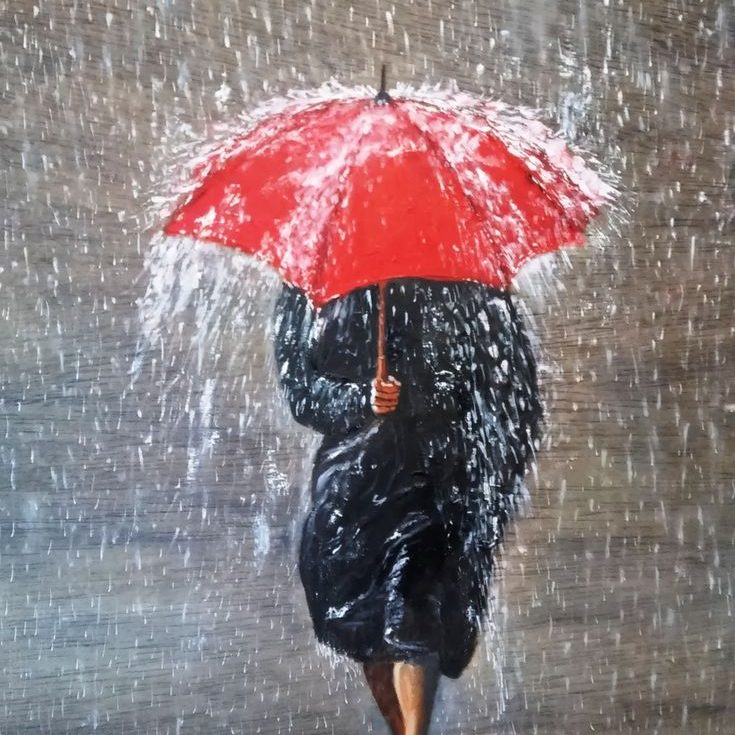
You walk in rain, you feel every drop—the cold, the weight, the way it soaks through your clothes. The water runs down your face, seeps into your sleeves, and collects in your shoes. It’s uncomfortable, but it means you’re fully in it. After a while, though, the rain doesn’t just make you wet. You start to notice your body. Your clothes cling to you. The wind cuts through the fabric. Your body starts to shiver in that quiet, involuntary way it does when warmth is leaving faster than you can replace it. At some point, you realise you’re not just standing in the rain anymore—you’re being worn down and drenched by it.
And eventually you get tired of being drenched. So, you buy an umbrella. Now the rain still falls, just as heavily as before. Storms still pass through the same streets. But most of it never reaches you anymore. It hits the fabric above your head and slides off the edges. You can still see the rain. You can still hear it tapping against the umbrella. You’re just no longer standing in it, shivering.
This, dear reader, is not nonchalance; it is the outcome of exhaustion.
And here is why I accept apathy with open arms.
Those who express apathy more are seen as cold-hearted. I’ve been told this directly several times; for some odd reason, they believe we are utterly emotionless- when that’s not the case, we were once empathetic souls, ones that got abruptly drained out. I believe that the apathy within is not an absence of emotion. It’s clear. It’s the silence after a long, loud noise — the disorientation before your hearing adjusts. Perhaps for the first time, you are not performing care. Not performing interest. Not performing easily. And because you’ve been performing for so long, the absence of performance can feel like the absence of feeling itself. It isn’t. It’s just what you look like without the costume on.
There is also something important happening underneath the flatness: the old reward system is recalibrating. Fawning kept you regulated through external approval — a smile from someone you’d helped, the relief of conflict avoided, the hit of being needed.
When you stop fawning, those hits dry up. Your nervous system, for a while, has nothing to reach for. That lack of pull is real. It’s also temporary. Desire and preference and genuine care all return — but they return on your terms, not as fear in disguise.
One of the hardest things about leaving Fawn behind is the guilt. The creeping sense that you are being selfish, cold, or difficult. That people are noticing. That you used to be better, warmer, more available — and something has gone wrong.
What’s actually happened is that you have stopped subsidising your relationships with your own wellbeing. You have stopped doing emotional labour that was never yours to do in the first place. And yes, some people will notice. Some will even be upset. That information is useful. It tells you about the dynamic, not about your worth as a person.
You are allowed to not know what you want right now. You are allowed to be unavailable. You are allowed to feel nothing particularly compelling about other people’s crises while you get reacquainted with your own inner life. This is not cruelty. It’s convalescence.
You spent a long time being everything to everyone. The least radical thing you can do right now is spend a season being nothing in particular, and seeing what grows.
Apathy, in this context, is a phase of integration. The self that you suppressed in service of keeping others comfortable is slowly, cautiously checking whether it’s safe to come back. That takes time. It takes quiet. It takes you not to rush it with a new project, relationship, or performance.
On the other side of this — and there is another side — is something that fawn never gave you: genuine engagement. A connection that doesn’t cost you. Care that comes from wanting to, rather than needing to. Opinions. Preferences.
The ability to disappoint someone and survive it.
It doesn’t mean you’re broken or selfish, or that you’re doing it wrong. It means you stopped running on a fuel source that was burning you down — and your body is figuring out what comes next.
I’ve learned not to be so ashamed of it. To understand that protecting what little is left isn’t selfishness. It’s basic maintenance. Like closing the door in winter so the heat doesn’t escape. It’s not that I don’t care about their cold. It’s that if I open the door, I freeze too. So now I choose carefully who I let in. Not everyone. Not always. And when I can’t, I say no or stay quiet, but I don’t force myself. Empathy stopped being a moral duty and became something rare and costly, something I only spend when I can truly afford it, because empathy is never meant to be a weapon against oneself.
As a reader, this is what you should take from this:
Are our brains doing the right thing by becoming the very thing it used to hate?
No, but it is the most human thing it can do, to protect itself.
Do we care?
Yes, of course we do, but only to an extent.
Do we care like we used to?
Nope.
Will we let you know that we care?
Fuck.no. 🙂
 The Inner Lens
Leave a comment