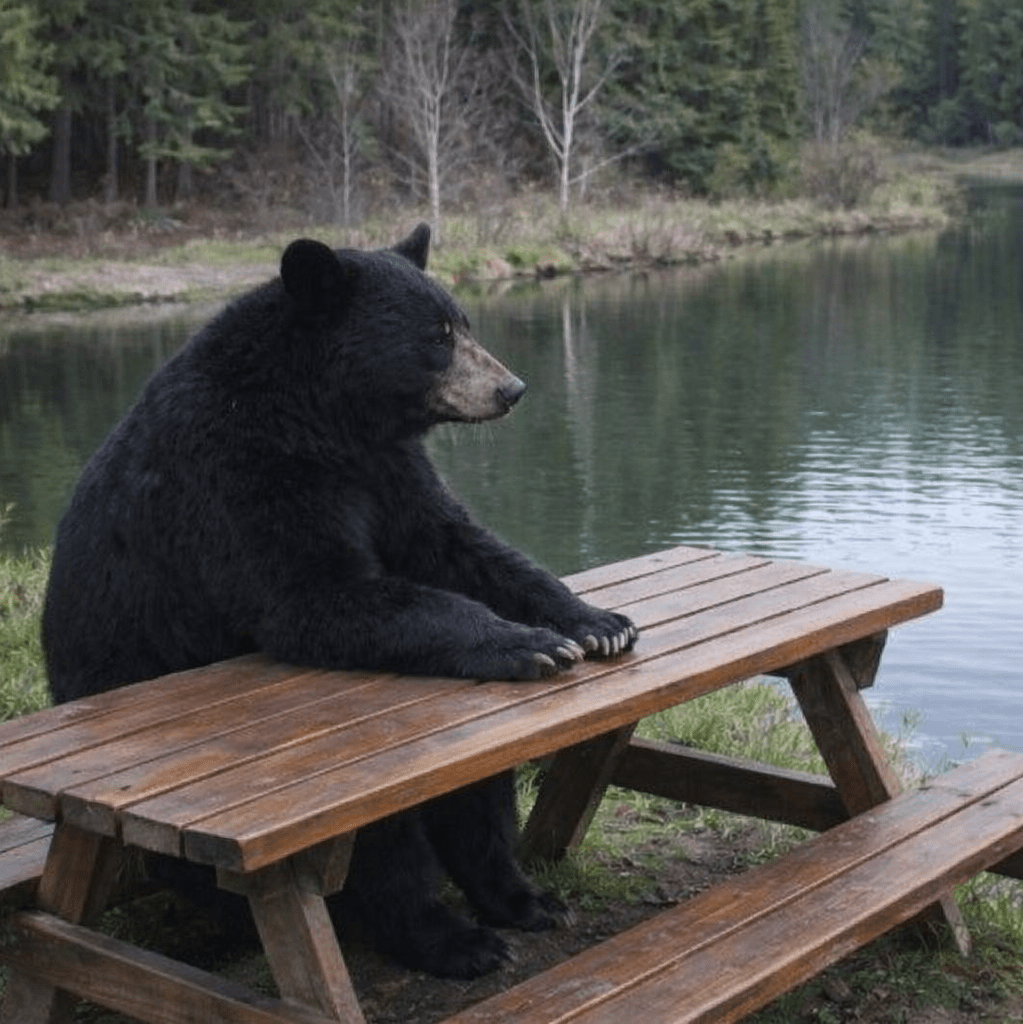
“I am not frightening because I am cruel,” the bear said quietly. “I am frightening because I am honest.”
At the hour where the day forgot its obligations, I would meet with a bear at the same bench. This bench faced a pond where nothing dramatic ever occurred, the water barely moved. I met the bear without a beginning. There was no moment I could point to and say this is when it started.
One moment the bench existed, the pond stretched out in front of it—flat, obedient, uninterested in spectacle—and the next, the bear was sitting beside me as though it had always kept the space warm. I never asked why the bear was here, and the bear never asked the same of me – we just accepted the arrangement the way tired people accept silence.
All I knew at the time is that it felt important, though I didn’t know why. We sat there, at opposite ends, sometimes facing each other, sometimes watching the motionless pond, as the world continued in its smallest possible way.
We never addressed the strangeness of it all—how a bear could sit calmly on a bench, how I could speak so freely to something that should have terrified me. The absence of explanation felt like a rule. The moment I thought to question it, the thought seemed unnecessary, like asking why water stays level. The pond stayed unchanged. The bench remained sturdy. Nothing arrived to interrupt us. And in that stillness, I realized something quiet and unsettling: I was not performing. I was not defending myself. I was simply present.
At first, our conversations were cautious. I spoke in abstractions—work, time, the dull ache of wanting something unnamed. The bear listened with an attention that felt almost invasive, as if it could hear the thoughts behind the words. When it responded, it did not offer advice. It simply described things as they were: hunger as hunger, fear as fear, rest as something that must be taken, not deserved. I remember thinking how odd it was that the bear sounded less like an animal and more like a part of me I had misplaced.
One day, at the very same hour, where the day once again forgot its obligations, I asked the bear why it goes out of its way to climb trees for bee hives, knowing that it will be swarmed and stung, why it goes through all this hassle for some mere honey when food elsewhere is obtainable.
“I climb the tree knowing I will be hurt,” it said, resting its weight on the bench. “The bark cuts my paws. The bees will come for my eyes. I do not misunderstand this. I calculate it and climb anyway.” The bear lifted its head, not with longing, but with recognition. “You call this desire,” it continued. “You dress it in better words. Purpose. Love. Ambition. Meaning. But it is the same motion of the body toward sweetness – ‘I do not believe the honey will save me,” the bear said. “I believe only that I will taste it. That is enough to move me.”
I was confused, so I asked why for something that is not permanent, why go through this for something short lived.
“You wonder why you suffer for things that do not last, why you endure the stings of time, rejection, failure. You ask what kind of creature would choose this.” It glared across the pond. “A living one.” The bear closed its eyes, as if it was tasting the honey on its tongue as we spoke. “The sweetness is brief,” it said. “So is the pain. What remains is that I reached.”
“You think I am reckless,” it said gently. “But you are the same. You climb careers, people, dreams. You tell yourself stories about why. I tell myself none. I just climb.”
I understood, finally, that the lesson was not in the honey or the stings, but in the honesty of the motion itself—the courage to want something enough to climb, knowing exactly what it will cost.
Before I could allow the silence to grow too loud, I asked him what if giving too much love is truly a form of hostility against oneself, what if what we think we deserve is the thing we cannot obtain nor handle, what if gods greatest test is giving us what we most desire, what then…
The bear considered this for a long time. It did not answer the way humans answer, by trying to resolve the question. It answered the way weather does—by revealing a pattern.
“You speak as though love is only something poured outward,” the bear said at last, voice low and steady. “As though it does not also leave a hollow behind. When I give too much of myself to the hive, the bees do not thank me. They defend what is theirs. Still, I do not call the climb a mistake. I call it a lesson written in stings.” It shifted its weight, claws pressing into the wood. “Hostility toward oneself is not in the loving,” it continued. “It is in the forgetting of limits. Hunger does not ask what I can handle. Wisdom does.”
The bear lifted its head. “You fear that what you desire will undo you. Sometimes it will. That is not punishment. That is exposure. When you are given what you want, you are shown who you are when there is nothing left to blame.”
It looked at me then, eyes dark, unflinching. “If the gods test you, it is not by cruelty. It is by permission. They let you touch the thing you believe will complete you and watch whether you can hold it without disappearing inside it.”
The bear rose slowly, adjusting its position. “If you cannot,” it said, “you learn restraint. If you can, you learn responsibility. Either way, the gift is not the desire fulfilled, but the knowledge of your own measure.” Then it fell silent again, as bears do—leaving me with the question not answered, but properly weighted.
And with this weight I followed it up with my thought spoken aloud, that sometimes I feel as though my existence is a form of punishment for the sins I have not committed, but rather for the ones my ancestors did. There are rules and boundaries and checklists That I did not write, yet my entire storyline is decided upon how obedient I am when it comes to following.
The bear listened without moving, as if the words had weight and needed somewhere solid to land. When it finally spoke, its voice was not unkind, but it carried the gravity of something that has survived many winters.
“You are born into a forest already marked,” the bear said. “Paths cut by paws long gone. Traps set before you learned the smell of iron. You call this punishment. I call it inheritance.” It turned its head slowly, eyes tracing the distance. “I do not choose the scars on my body. I inherit the memory of fire, of hunters, of hunger passed down in muscle and bone. Still, each day, I decide where to place my feet.”
The bear lowered its gaze to the table between us. “Rules are not written for fairness,” it said. “They are written for order. Survival. Control. Some keep you alive. Some only teach you how to obey. Wisdom is knowing the difference.” Its voice softened. “Your life is not a sentence. It is a negotiation. You are allowed to question the fence, even if you cannot yet climb it. You are allowed to refuse the story that says obedience is the same as worth.”
I too lowered my gaze upon the table between us, allowing myself to sit, to marinate into the words the bear spoke, for that’s all I could do.
The bear noticed my silence, “You are not here to atone for ghosts,” it said. “You are here to decide which lessons you carry forward, and which end with you.”, as if to say: the past may shape the forest—but the next step is still yours. “No matter how fast you run,” the bear added, “no matter how fiercely you hunger for the end, your lungs will shake. Mine do. Yours do. The body always reminds us of the cost.”
It shifted its weight, I came to notice that the bear could never really sit still, it was always shifting or fidgeting in one way or the other when speaking from his thoughts, I saw myself in him in those small moments. “You think desire carries you forward,” it continued. “It does not. Desire is loud, but it tires quickly. What keeps a creature moving is endurance—the quiet agreement to take one more step while the chest burns.”
The bear looked ahead, not at the finish line, but at the trees just beyond the pond before us. “I do not chase the end,” it said. “I survive the distance.”
And what if the distance is continuous, what if you are heading into nothing, I had asked him.
The bear did not answer right away. It inhaled, slow and deep, as if testing the air for something unseen.
“Then you walk anyway,” the bear said.
It lowered its head, voice steady. “The forest does not promise an edge. Winter does not promise relief. Many paths do not end in triumph, only in continuation. Still, I move.” The bear rubbed its eyes with its large paws. “You are afraid that meaning requires a finish. That endurance must be rewarded with arrival. But distance does not owe you a destination.”
It looked at me then, once again, eyes dark and calm. “If there is nothing ahead, then the act of walking becomes the thing. Breath becomes purpose. Presence becomes proof.” The bear exhaled. “A creature does not live because the path ends. It lives because it is alive while moving.”
I stared back at the bear, processing and putting together his words, and then I turned to look at the pond, as did the bear. What I loved most about our meetings at the bench was the access to the pond, when words spoken aloud and the silences between became too heavy, we retreated back to the pond. Something about it being motionless brought a presence of calmness, a presence of realness. That everything the bear had spoken was truth, whether it was something I wanted to hear or not – he always had an answer to every question mark.
And that made me question why people feared bears, as my eyes retuned back onto the bear, I examined what was sat before me. The bear is not loud in the way fear imagines. It does not announce itself with violence or spectacle. It is a mass of patience—thick fur holding warmth, breath moving slow and deliberate, eyes dark with the kind of awareness that has nothing to prove. When it stands still, the world seems to adjust around it.
People say bears are dangerous, but they never mention how carefully a bear listens. How it knows when to advance and when to sit back. How its strength is not restless, but contained, folded inward like a truth waiting to be asked for. Its claws are honest. Its weight is honest. There is no performance in it.
And then finally, hesitant at first, my tongue lets out the question – why do people fear you?
The bear smiled in the way only bears can—without showing it.
“People fear me,” it said, “because I am honest about my size.”
I frowned, and the bear continued, voice slow, patient. “I do not soften my weight to make others comfortable. I do not hide my hunger, my anger, my tenderness. When I feel, I feel with my whole body. That unsettles those who survive by trimming themselves down.”
It glanced down at its paws—large, scarred, capable. “They see my teeth and imagine violence. They see my strength and assume loss of control. They do not stay long enough to notice restraint, or tenderness, or the way I sit with questions instead of tearing at them.” The bear’s voice softened. “Wisdom is unsettling when it does not ask permission. Emotion is frightening when it is not neat. I carry both openly. Humans prefer these things hidden – people fear what cannot be controlled, and they fear most what reflects them without permission.”
I asked why they run.
“Because I remind them,” the bear answered, “of everything they have learned to cage. Their instincts. Their grief. Their love when it was too much. Their rage when it was justified. I stand where they buried those things and I do not apologize for standing there.” The bear’s gaze lingered on me now, longer than before. “They call me dangerous,” it said softly, “when what they mean is familiar.”
Something in my chest tightened.
“I am feared,” the bear went on, “because I carry truths people spend lifetimes pretending, they have outgrown. And when they see me, they feel the weight of what they abandoned to survive.”
I ask why he doesn’t explain himself before they run away.
“I do not chase, I do not seek harm—but their fear is louder than my reason. you learn to know that kindness can be taken advantage of, that your good intentions and pure heart can be another’s excuse to continue with unfairness. Be kind, but be limited; your kindness should not be a free-for-all, and you should not make it an accessible weapon that others can use against you. My silence is a boundary, a quiet protection, not malice. Sometimes, it is safer to wait and let understanding come in its own time rather than force it in words.”
It leaned close, close enough that I could hear its breath—my breath. “You do not fear me,” it said, almost kindly. “You sit with me. You listen. You ask questions.”
Because I understand your language, I had thought to myself as this creature and I shared the same air.
The bears eyes were steady. “Tell me, “It asked, snapping me out of my thoughts, “how do they react when you feel deeply? When you speak without trimming your truth? When you do not make yourself smaller so others can feel safe?”
The air grew still.
“They fear me for the same reason they fear you,” the bear continued. “Because depth looks like danger to those who live on the surface. Because power that chooses gentleness confuses them. Because a being that knows its own weight cannot be easily controlled.”
The bear leaned closer, close enough that I could feel its breath now—warm, steady, unmistakably alive. Its muzzle filled my vision, scars etched into fur like old stories, eyes dark and calm, not searching for permission. It was the kind of closeness meant to rattle something loose.
Fear hovered, waiting for me to flinch.
But I didn’t.
The bear held there, unhurried, as if daring fear to justify itself. Its presence was overwhelming only in size, not in intent. There was no snarl, no tension in its jaw—just an unblinking honesty, so near it erased the space where panic usually lived.
“I am not frightening because I am cruel,” the bear said quietly. “I am frightening because I am honest.”
Its breath washed over my face again, and I realized how strange it was that nothing in me wanted to run. The closeness did not feel like a threat. It felt like recognition. Like standing before something that refuses to soften its edges for comfort yet has no desire to harm.
The bear did not move away. It didn’t need to. Fear did first.
It paused, then added, almost tenderly, “And so are you.”
And in that moment, as the bear receded and leaned back into its seat, I understood then why the bench felt familiar, why I never questioned the absurdity of meeting a bear on a bench to talk, why when I arrived tired, it was already slouched. When I felt restless, its claws dug into the dirt. I finally understood why the bear spoke with my voice before I recognized it – I was never sat on bench looking at a beast, I was looking at myself—unshrunk, unmuted, finally allowed to exist.
The realization did not arrive as a shock. It arrived as a simplification. There was no longer a need to imagine the bear’s thoughts, because they followed the same paths mine did. Its patience was my endurance. Its aggression, my anger finally unhidden. It’s quiet was not emptiness but a refusal to waste energy on noise. I understood then that the bear was not accompanying me; it was containing me.
That day was the very last day I ever saw the bear. I sat at the bench, alone. Or perhaps I sat complete. The pond was unchanged. The bench held the same shape. Nothing had been taken away. What had happened instead was that I no longer needed a body outside myself to hold the weight of my questions. I had learned the posture. I had learned how to listen.
If I ever see the bear again, it will not be as something separate. It will be in the way I pause before answering, in the way I allow silence to finish its work. It will be in the knowledge that when I sit with my thoughts now, I do not need a companion. I have already become one.
The bear is you without the performance. Your instincts, your fears, your patience, your hunger for meaning—all compressed into something honest and undeniable. Sitting with it is what happens when you stop arguing with yourself and start keeping yourself company. The bench is the pause you rarely allow. The conversation is existence noticing itself.
And when you finally stand up and walk away, the bear doesn’t follow. It was never meant to. It was only there to remind you that you are already sitting with yourself—whether you choose to listen or not.
 The Inner Lens
Leave a comment