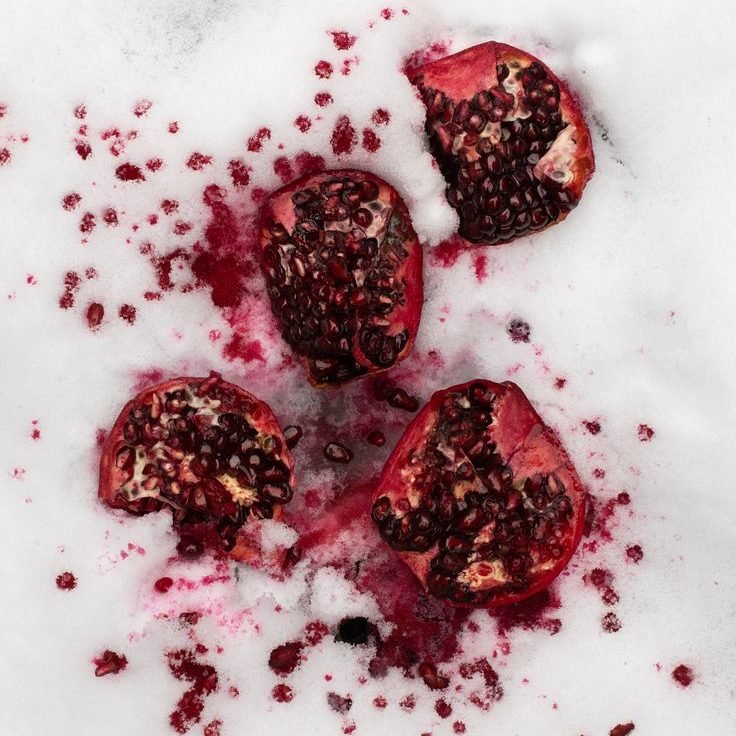
“But to peel a pomegranate is to agree to linger, to stain, to choose devotion over convenience. And perhaps that is why so many turn away— not from the fruit, but from what it asks of them.”
The pomegranate grows in regions often silenced. From North Africa to South Asia, and South America to the Middle East, and within the Middle east to the beautiful doorstep of my home – it is native to lands marked by occupation and extraction. As far as memory will allow to carry me into the landscape of childhood, I can remember my nanas garden, besides from her roses that she tended to as if they were her children, I remember the rows upon rows of pomegranate trees, their branches heavy with bruised-red fruit, split open by the sun. I’ve always favoured pomegranates, as they carry a silent whisper of culture, of back home.
Besides from merely being some fruit, I have pondered on the thought of what it means to be pretty like a pomegranate, as they are something that doesn’t try to impress you – it just does. It’s not the kind of fruit you reach for at a party, matter of fact, it’s not the first fruit you reach for straight away when possessing an urging hunger. It doesn’t peel easily like an orange, It’s hard. It’s stubborn. It stains.
It demands your attention, your patience, your hands. You’ll almost always make a mess. Your fingertips turn red, juice will find your sleeve and if not careful, it’ll paint the canvas of your face, and seeds will jump to places you didn’t expect.
And the more thought I put into it, the more I came to the realisation that this mere fruit is awfully a lot like people.
From the outside, pomegranates always look fine, almost if not perfect. Round. Glossy. Put together. You can line up five of them side by side and never guess which one is sweet, which one is bitter, and which one is already quietly rotting inside.
Just like us.
We walk around in skins, we’ve polished clean clothes, practiced words, and half-meant smiles. We keep ourselves “together.” From the outside, we look functional. Stable. Whole. But no one sees what’s really happening beneath the surface.
Some of us are full of joy. Some of us are dry and tired. Some of us are both in the same day. There are people who laugh loudly and go home to silence they don’t know how to sit in. There are people who give generously but feel completely hollow. There are people who don’t know how to say, “I’m not okay,” because they’ve gotten so good at being “fine.” Each crimson seed is a hidden truth, a story held, nestled between tough layers of skin – waiting to be uncovered. Each layer a testament to the commitments and consequences we endure when we dare to lay our hearts and minds bare. And to peel back a layer is to engage in an intimate dance, a tender vulnerability.
But not many see beneath the skin, simply because peeling a pomegranate is a tedious task, as it takes too long, the juice stains the fingers, and the seeds scatter like spilled hours across the table.
But to peel a pomegranate is to agree to linger, to stain, to choose devotion over convenience. And perhaps that is why so many turn away— not from the fruit, but from what it asks of them.
A pomegranate doesn’t offer itself easily. It stays sealed, holding its weight in silence. From the outside, it looks intentional, even restrained, as if nothing inside it is pressing to be felt. That’s the illusion we learned to perfect – appearing whole while carrying an interior that is crowded with history. People often mistake that composure for simplicity. They don’t realize how much force it takes to keep everything contained – how it is a delicate yet chaotic negotiation between the desire to protect ourselves and the yearning desire to be known.
Inside, nothing is singular. There are hundreds of pieces, each one its own small truth. Memories don’t arrive in order; they press against each other, sweet and bitter at the same time. Joy is never untouched by loss. Love is never free of fear. This is what depth looks like when it has nowhere to spill but instead remains contained and sealed.
Opening a pomegranate is an act of rupture. There is no gentle unveiling—only splitting, breaking, exposure. The juice bleeds. The seeds scatter. It leaves marks that don’t wash off easily. That mess has always scared people. We were taught that to be worthy of care, we needed to be tidy, palatable, easy to hold. So, we learned to stay closed, to let people admire the surface rather than risk what would happen if we broke open in their hands.
But there is a quiet grief in being admired without being known. When people only love the shell, they never commit to the weight of what’s inside. They don’t stay long enough to understand that depth is not disorder—it’s accumulation. It’s what happens when you survive, remember, and keep going anyway.
Being pretty like a pomegranate means accepting our own complexity without shame. It means understanding that the mess is not a flaw, but evidence of abundance. That staining someone’s hands doesn’t mean we are harmful—it means we are real. Pomegranate were never meant to be consumed cleanly or quickly. They are meant to be encountered with patience.
If someone wants to know you, they will have to accept the rupture. They will have to sit with the scattered pieces, the contradictions, the sweetness that arrives alongside ache. And if they don’t—if they choose only the surface—then perhaps they were never meant to taste what you carry. Because before one can have taste of a pomegranate, they must first tear open its protective shell, get its sweet blood on their hands. And only then will they truly earn and treasure the taste a pomegranate has to offer.
So, I come to conclude that – if pomegranates are so beautiful and worth the mess, then maybe, I can too, be beautiful and worth the mess.
 The Inner Lens
Leave a comment