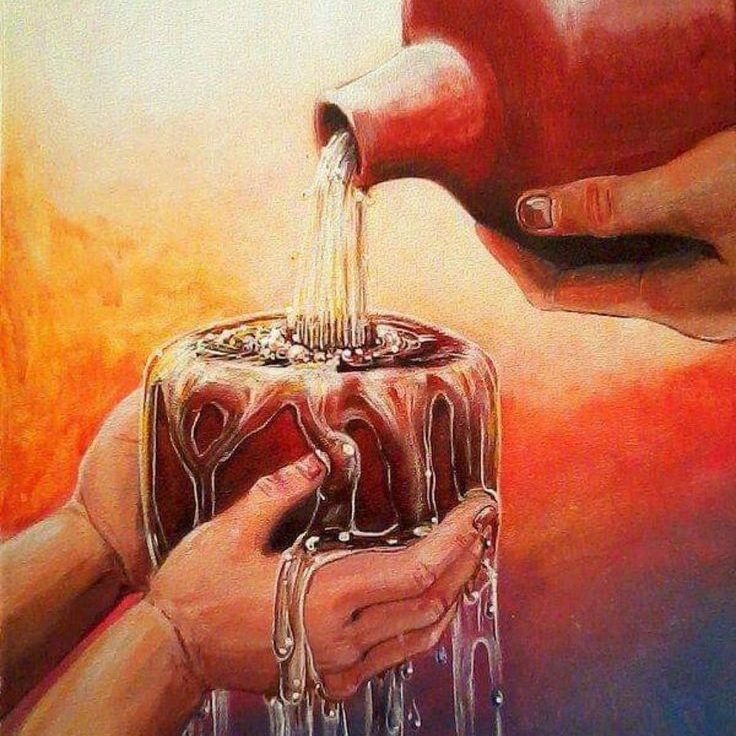
‘If you cup is already full, why not take a minute to drink and enjoy what you already have, before reaching for the jug to fill your cup again. You can always have more, but why not when there’s room to fill your cup again?’
One thought that tends to appear every now and then for me is the subject of happiness, more specifically how happiness does not equal permanence. There have been countless experiences, ones I’ve lived through personally and those that I’ve witnessed others experience – each and every one of them leading to the conclusion and acceptance that happiness does not equal permanence.
I would go as far as to say that this statement has become a belief within my mindset, and I have a singular word explanation for this – greed.
Humans naturally have a want for more, and as long as we embody greed within our souls, happiness will never produce permanence for us. Simply because what comes before permanence of happiness is satisfaction, and due to our greed, and as long as we possess it, satisfaction is something that will never be fulfilled. That cup of satisfaction will either never fill or will eventually overflow and create a mess.
I have witnessed many situations, and have even fallen for this, where we could be so blessed with several different things, whether it’s a partner, a new job or something as small as the food in front of us ; rather than enjoying whatever that blessing may be in the moment, our minds instantly switch on what more we could have, what could be better – if we have this one good thing, who says we cant have something better. We could have the entire world in our hands and yet still not be satisfied. And of course there is nothing wrong with aiming to have more, or to have better – these are what goals are, these are what give us purpose in life – however, we tend to fall for the idea that once we gain one positive, then that cancels out all the negatives and more positives are now easier to grasp.
Greed becomes the poison to permeance of happiness if an individual lacks humbleness. Are you humble when you receive one good thing, or do you instantly jump for more? Do you appreciate your blessings in the moment for all it is, or do you come to understand their value when that blessing has passed and long gone.
‘Greed is a bottomless pit which exhausts the person in an endless effort to satisfy the need without ever reaching satisfaction.’ – Erich Fromm
This is where I came to an understanding – abundance requires control.
Abundance means having plenty or more than enough of something. To have control of abundance means having a lot of something is only beneficial if it is managed properly. Without control, abundance can turn into waste, harm, or chaos. In simpler terms – more is not always better unless guided by discipline, responsibility, or balance, all factors that abandon greed.
A full cup needs a steady hand. You can’t run with a full cup. A full cup demands focus. When you have a full cup, you can’t move like you’re carrying an empty one.
Abundance is almost always seen as a desired state. And one that is quantifiable. But, often, we can’t quantify the thing that would satisfy us. How much money do you need to never desire money again? What kind of relationship would keep you fully satisfied forever? How many friends? Could you quantify your desires?
It’s human nature to never accurately quantify abundance. We think we want more. We need more. When often, a version of us a decade ago would have killed for what we have today. Whether it’s relationships, health, intellectual success, or financial success — there’s something a version of you yearned for, for a long time. And you now take it for granted. Deem it inadequate, even.
Research confirms this. The hedonic treadmill shows us that lottery winners feel euphoric highs for short periods before stabilizing and returning to their baseline state.
We adapt. We recalibrate. We want more. We live life on an ever-shifting baseline, in search of satisfaction.
And it made me realize abundance is a discipline, not a desire. For us to produce a happiness or satisfaction that is permanent, it has to be done through disciple, not through simple desire, because desire is what leads humans to greed – discipline is what keeps us away from it.
Because what happens once you finally get what you want, but can’t handle it? What happens when the things you’ve been constantly demanding more of gets placed into your palms and you no longer know what to do from that point forward? The promotion you finally get, what do you do if that is what breaks you? The perfect relationship you’ve been screaming your lugs out for, what happens if it overwhelms you because you come to realise you haven’t understood your own inner state, let alone even try to understand another person’s?
Abundance without discipline is pure chaos – to want more, you have to be willing to take on more – and to take it on well.
The people I know with the most abundant lives take on the most. And they often share the most, not a spec of greed lives on their soul. Their abundance is a byproduct of surface area and goodwill. They take on more socially, at work, wherever. They develop a reputation for being high capacity. And as a result, the world continues to recognize and give.
And they know that abundance requires saying no. They understand the importance of when knowing something is enough, they are humble with what they have and appreciate it for all its worth in the moment.
Because that full cup can’t take on more liquid. Real abundance means protecting what you have. The discipline of subtraction. Every yes to more requires a no to something else, and most cases that something else is normally the biggest blessing yet, and you won’t be the one saying no – life will be taking that shot for you.
You can’t fill a soul-sized void with achievements. You could spend years getting to the destination and then you find it’s just a place. It’s Tuesday and you still must do laundry. The new car you fantasized about becomes just your car. Or you don’t even feel like it’s yours — you’re anxious you’ll lose what you have. The other shoe is going to drop at any moment, and you need to fight like hell to keep everything you worked for. Psychologists call this the happiness paradox – the people who care most about being happy report lower well-being and more symptoms of depression. Most cruelly, we are hit hardest by disappointment precisely when everything is going right and we think we “should” be happy, so you search for the next thing.
So many of us are chasing happiness, but what we actually want is meaning. Happiness is present-focused. It’s about feeling good right now. But happiness is fleeting. You cannot keep something that is fleeting in place via simple desire to want to keep it in place.
When people assemble furniture themselves — even badly, even with frustration, even when they could have bought it pre-made — they value it more. Not because they enjoyed the process. We all know that assembling cheap furniture isn’t fun, I spent days on designing and building my wardrobe and I didn’t enjoy a second of it. But the struggle itself creates attachment and perceived value, even if its slowly falling apart and jammed with clothing. This is called the Ikea effect, its not happiness we truly chase permanence for, it’s meaning.
And that’s the thing; we keep trying to engineer friction out of our lives. But friction is what creates meaning in the first place. The hard parts aren’t obstacles to a good life — they’re what make the good parts register at all. A meaningful life isn’t built by feeling good all the time, by seeking permanence in happiness, cause without a doubt happiness will never equate to permanence, or desperately trying to reach the next best thing, it’s built by appreciating what we have, by focusing on our already full cup and making sure it doesn’t overflow.
If you cup is already full, why not take a minute to drink and enjoy what you already have, before reaching for the jug to fill your cup again. You can always have more, but why not when there’s room to fill your cup again?
 The Inner Lens
Leave a comment